Friday, 8 July 2011

Tower of London, Olympic Site, Greenwich Village

Hello. I'm in Cornwall at the moment, the southwestern peninsula of Britain. I'll be here all weekend, but I managed to write alot on the bus, so this should cover the last couple of days, hopefully finishing with yesterday.
Note: I'm trying to get done before

Monday might've been the start of a new week, but the day actually began with a field trip instead. Our teacher decided to take take the class to the Tower of London.


The Tower of London is a huge castle built by William the Conquerer in 1066. The castle was a royal palace back in those days, and many kings and queens of Britain lived and died in these walls. But today it is better known for being the prison and final resting place of several traitors in British history like peoples Anne Boleyn and Lady Jane Grey, William Wallace, and Guy Fawkes.
Entering the first gatehouse, we encountered a tour guide who had just begun with an entire flock of tourists following behind. Realizing the crowd was to big to even push though, we decided to wait until the next one began in twenty minutes. We waited on top of the bridge spanning the old moat. Back in it's prime, this moat was twenty deep. But it also served as the drainage for all the sewage in the castle, and after several centuries it began to stink. So the Duke of Wellington ordered it to be drained and filled, and it was later turned into both grazing land for cattle and a vegetable farm.
After twenty minutes, our guide arrived. He was a member of the guard of this castle, a Yeomen Warder, though they are commonly known as Beefeaters.

Historically they are responsible for guarding prisoners and protecting the Crown Jewels, but today they function more as tour guides and attractions in their own right. Dressed in dark blue and light red, he was a somewhat comical sight, but one had to remember that these people were actually trained soldiers.
With a booming voice, he lead us through the gates. One of our first stops was the Traitor's Gates.

 This entrance on the River Thames was used to transport prisoners safely to the fort, and up those steps walked up some people like Anne Boleyn.
Continuing past the entrance to the Inner Wall, we got our first good look at the Tower of London.

It was an impressive square keep, punctuated by several square turrets and one round one, upon which the Royal Observatory used to sit.
We also got our first good look at the Ravens of the Tower of London. According to legend, the day that there was no Ravens left in the Tower, the Tower of London would crumble and the monarchy would fall. So for the last several centuries, Ravens have always been kept here.

These giant crows hopped along the ground inside the walls, their wings clipped to ensure they would stay. And just to be extra careful, a cage with a raven was kept along the base on another wall, tended by the Ravenkeeper.
The Ravenkeeper on the right.

The tour also took us by the execution site. Although only a small memorial remains now, it was at this point that people were killed. Here, they were typically beheaded. Beheading could be quick, as with one of King Henry VIII's wives, who died with a single chop, or much more painful. One victim took five chops of an axe, before it became stuck and the head remained by a strip of sinew, requiring the executioner to finish with his knife.After beheading, the head would be placed on a pike and left outside the entrance to London as a warning, as the body was buried in a unmarked grave.
This memorial marks the execution site.

Once the tour was finished we decided to go to see the Crown Jewels. After a long wait, we feasted our eyes upon some of the most lavish items ever to be made. Although the items were beautiful, it was a bit annoying to be here on the 4th of July and imagine that these items could have been paid for by colonial work. And even more disgusting was the thought that these items were the ones the Queen liked the least.

Our next place made me much happier though; the Tower of London itself was filled with armor and weaponry from the medieval times up to the gunpowder age. The keep had also been a weapons storehouse, so all manner of arms was stored here. Full suits of amor, built for a king were here, as well as warhorse armor, swords, maces, glaives.


There was even a couple of interesting ideas for early guns. One such fearsome idea was a mace built with a gun in the handle. There was also some early muskets, as well as some cannons and mortars. One cannon was even tri-barreled, demonstrating again the creative ideas that these inventors came up with.
Our last stop in the castle was the Torture Room and the Bloody Tower. The torture room was small, but had some interesting artifacts, such as the stretching rack.

The Bloody Tower was also the site of one of the great unsolved mysteries of history. Here, two young princes went missing, both in line to be king. Centuries later their bodies were found, but the murderer was never caught (though many like myself believe the next king probably did it.)

That night I decided to celebrate Independence Day by cooking burgers and buying some apple pie, what seems to me like a classic American meal. I had planned to go to the Benjamin Franklin museum, setup in his old house, but didn't end up having time to do that, since we had a meeting for our Cornwall trip.
And now for anyone interested, I shall end my post today with a small interesting story in celebration of our Independence, on the story of the song "Yankee Doodle." If anyone isn't interested, just go ahead and stop reading and skip to the next day.

Yankee Doodle was a song first invented by the British during the French and Indian War. It was intended to mock the colonists, as can be seen by the lyrics.
Yankee Doodle went to town
Riding on a Pony
Stuck a feather in his cap
and called it Macaroni
Doodle is thought to come from the German word dudle, which means fool or idiot. Macaroni was a style of French fashion. So the idea was that this idiot thinks that sticking a feather into his hat was fashionable.
Strangely enough, this song actually became popular in the colonies, and they began to adapt new lines to add for themselves. Infact, this song would be sung in both the start and finish of this war.

As the minutemen routed the redcoats during the Battles of Lexington and Concord, they sent the British troops into a full retreat, and as they chased, they sung this song to the British. After resting, one british officer reportedly asked the other quote.

 This song was also sung after the Battle of Yorktown. As the British were finally defeated by the combined American and French forces, they left the keep and surrendered their arms to the French. This symbolically showed that they believed France defeated them; not the colonists. The French would not let this insult stick though; as they surrendered their arms, the French army began to play Yankee Doodle as a gesture to the Americans.

Hope this brief story was interesting. Tomorrow is the Olympic Park and Greenwich.


The morning began with a trip to Greenwich, the site of the Olympic Games next year in London. After another hour of traveling along the metro, we reached our stop.
Stepping out of the underground opened us up to a bleak scene. We were on the edge of a motorway, with trucks blasting by. Buildings looked rundown, with barbed wire topping the fences. It looked like a pretty beat-up side of town. Our tour guides explained some of the background of this place. The site of the Olympic Grounds had some bad history. During the Industrial Revolution, this had been a dumping ground for pollution from this industry heavy area. As time went on, many of the places around here became vacant and left to crumble. One reason why the games were actually chosen to be hosted here was the promises that Britain made concerning these problems; they promised to clean the pollution, restore the enviroment, tear down old buildings and create better ones, and provide new jobs for the area. As we first walked along a walkway, he explained to us how much work had gone into it. Many small waterways slice through this area; thin rivers, just big enough for a small boat to navigate through them. These had proven to be a benefit to construction of the buildings; using these, as well as the new train system that had been built, they were able to ship materials in a much more efficient way, cutting thousand of lorry jobs with higher CO2 emissions. But the waterways themselves had been a mess. The water was filled with high levels of arsenic, lead, oil, and other dangerous pollutants. They had to clean them, and dredge the waters of trash. Among the trash collected were shopping carts, tires, cars, and even some unexploded ordiance left over from World War II. Afterwards they restored native wildlife, as well as a marshy area as a wildlife reserve.

Moving closer, we finally got a good view of the site. The Olympic Stadium was the main highlight; on the outside, one  could see the steel ribbing crisscrossing, while steel and glass "shards" cut the air on the ceiling. The stadium at it's peak could hold 80,000 people, but could be dismantled later to 25,000, allowing the materials to be recycled once again. Recycling was a huge theme of this venture; while tearing down the old buildings, the committee decided to set a goal of recycling 95% of the materials. They ended up recycling 98%. One could also see the aquatic center nearby. Two triangular prisms, their points facing each other, supported a giant grey blob. It was meant to look like a Stingeray, but many people have nicknamed it the Whale's Tounge.
This picture is the closest one I could find to what I saw. The Stadium is on the top, and the Whale's Tongue/Stingray is on the bottom.

These audience seats in the prisms were also meant to be dismantable. Many of the other smaller buildings also could be taken down; infact, one was scheduled to move towards the site of the 2016 games, to be used there. Everything was intended to be reusable and recycable. The apartments of Olympic Village would be turned into both housing, and a school, whose emphasis on sports would fit the nearby sports venues that would be vacated once the games were over. And the games also showed that other buisnesses were picking up as well; nearby, skyscrapers were being built. It seems like the games had had a positive effect on the entire community here.

After taking the train to Greenwich, we were left to our own devices. Greenwich is the site of one of the Prime Meridians, diving the earth into two hemispheres. This also makes it a prime location because of the time change; in the morning they can trade with Japan, and in the evening they can trade with the U.S. Our big goal here was to visit the Prime Merdian and straddle it so we were in two hemispheres. However, finding it was a tricky buisness. There was a fancier site where one could take a picture for 10 pounds, or a simple free one. We also had to climb a hill, and the direct path there was blocked by a Pre-Olympic equestrian event. After finally navigating our way through, we found the small, free line denoting the Meridian, took our picture, and left.

The girls, hungry and tired, decided to go off, while I visited the Maritime Museum.

 Dedicated to Britain's nautical history, it covered various periods of the beginnings of sailing in Europe, the exploration of the Americas, the slave trade, and the search for the South Pole. It was a very well done museum, but many many exhibits were closed at once for renovations, so I saw probably about half of what it normally offered. After finishing, I jumped on a train and headed home.

Sorry for all the text and few pictures, it was difficult to find good pictures of Olympic Site, and I'm in a rush. We are leaving for the day soon and I won't have internet until tonight. More tonight/tomorrow hopefully.

Wednesday, 6 July 2011

Changing of the Guard, National History Museum, and Hyde Park

Sorry for the late post. I've been working on planning a trip to Normandy and it's been a nightmare. Flights to nearby cities, flights to Paris and then a train, trains from London to the city; it's all been a giant mess. Now I'm gonna try to take a ferry but with my available time after class it's really hard to plan out when I can take the train.

This particular Sunday was a long day.

It was the first morning we had off since classes had started, and a small group of my flatmates and I decided to go to the Changing of the Guard ceremony in front of Buckingham Palace. Since it occurs at 11:30 A.M., we had never previously had a chance to witness this, so we made plans the previous night to get a proper English breakfast, take the tube, and arrive early for a good spot.

Of course, plans never work out. We left late, to the point where we decided just to eat breakfast at the first place we saw. Being a Sunday, many typical places were closed, and when we finally got to a place, the service took such a long time that we were still behind. In fact, after taking a hurried and haphazard metro route to the palace, we were there minutes before it begun. Yet we had already lost the valuable advantage of arriving early.

Note: I'm still having camera issues so these are still not my pictures, but are meant to convey how the actual ceremony looks.

Crowds thronged every inch of the entrance. People pressed against the gates and along the barricades setup to clear a path for the soldiers. People were on the pedestal of the fountains, climbing some of the smaller statutes to get a better look.

It was pandemonium.

While jostling for a place, the old, tired guard assembled out of sight on the far side of the courtyard. It proved impossible to get a good spot, but we settled at the back of the crowd, close to the main gate as we heard the faint "thump" of a bass drum on the distance. As it drew nearer, one could see the black hats appearing over the heads of the crowd. Finally they rounded the fountain.

Two groups of soldiers, dressed in their red tunics and black pants with their bearskin hats, marched through the clearing. The first was a small marching band, led by the drum major.

Behind them, a decorated soldier wielded a sword in front of about forty soldiers, holding SA80 assault rifles fixed with bayonets, as they silently marched step in step, the sound of their boots crunching in harmony upon the gravel below.


As they entered the courtyard, the soldiers faced their comrades on the other side of the courtyard. As the band played a tune behind them, they slowly marched into a closer position. Apparently the tune the band plays is different for each particular regiment. The officers, one from the old and one from the new, met each other in the middle while still brandishing their swords, and then began to change the guard.


A small group of soldiers accompanies each officer and replacement as they move to the guardhouse.


As they marched around each guardhouse, checking it and replacing the old guard with the new one, the band played in the middle, while two guards carrying their regiments flag patrolled the grounds.

After the guards were changed and the music over, the old regiment headed home, while the new one headed to their barracks. It was a pretty impressive spectacle, but the old guard was not actually the traditional British Grenadiers. It was something with a dark uniform, definitely not the standard uniform. Sometimes special honors are given to foreign troops, to guard Buckingham and participate in the ceremony. But I haven't been able to find out which troops these were yet, but I believe they from the Queen's Color Squadron, a regiment with ceremonial duties from the Royal Air Force.
Fun note: The Queen's Guard is made up of forces from five sections: the Grenadier Guards, Coldstream Guards, Irish Guards, Welsh Guards, and Scot Guards. One can tell where they came from by their arrangement of buttons on their tunics and other small details. For example, equally spaced buttons indicates Grenadier Guards, while buttons in groups of 5 indicates the Welsh Guard.

This is an official video about the Changing of the Guard. It has some interesting information as well as some good footage.


The other members of my flat, being shorter girls who couldn't see a thing, had long since abandoned the Palace before the event was over. So, being on my own, in a new corner of town with time to kill, I decided to strike out and visit the Museum of Natural History.

As I left the area, I passed around several monuments decorating the interior of a gigantic roundabout. The most imposing building here was the Wellington Monument.

It commemorated the Duke of Wellington,the British Commander who fought against Napoleon, and ultimately defeated him in Waterloo. Nelson and Wellington pretty much make up the two biggest war heroes to the British, and both fought against Napoleon. It also apparently functions as a vent for the London Underground, which is kind of neat. It even holds a tiny police station inside of it.

Continuing on, it became clear I was entering a very high-class section of town. The hotels were lavish, and super cars passed you every minute. Aston Martins, Rolls Royce and Bentleys were as common as Mercedes.   There was even a Ferrari dealership along the street. I assume that because of it's proximity to the Palace, this area was filled with rich people. After getting a quick lunch, I finally found the Natural History Museum.

Entering the Museum immediately took you face to face with the skeleton of a brontosaurus.

 After looking at some other fossils, I decided to head into one of the wings. Unfortunately the Dinosaur section was under construction so it was closed, which was a bummer. So instead I entered was on humans. It had a delightfully informational interactive exhibits about human development and biological processes. It covered about half of what I learned in Bio 1, and I managed to use this knowledge to impress nearby tourists by successfully answering several trivia questions.

The next section looked at some of the larger mammals and animals in the world. One noteworthy exhibit was the sea mammal section. A large model of a Blue Whale hung in the middle of the room while other whales swam around them.

It was very interesting, but unfortunately it was all on things I already knew. After correcting a mother that the dolphins were in fact, not sharks, I headed toward another animal exhibit. After going through a insect room, I found myself in a room with stuffed birds. Some really neat species were here, including several extinct species like the Dodo bird.

The next room was the entrance to a mineral room, which, getting a bit tired, I went quickly through,before leaving the building.

Nearby was Hyde Park, so I decided to walk through that before taking a bus home. As I walked towards the park, I passed a building that still had scars from the bombing runs in World War 2. Arriving in the park completely drove any thoughts of war out of my mind though.

Hyde Park was massive. I had thought that Regents Park was big, but this was even larger. I was too exhausted to explore every corner, and decided just to meander towards the bus route and look at it better later on.

The first thing I saw was a giant monument to Prince Albert, the husband of Queen Victoria, the longest living British monarch ever. His death devastated her so much she only wore black in public ever again.


The park itself was decorated with short grass, periodically sprinkled with small white flowers. The middle of the park was cut by the Serpentine, a large lake that gave access to some boating.

 On one corner was a memorial fountain to Princess Diana. Unlike a traditional fountain, it was a long ribbon cut into a rough circle like shape, filled with shallow water, allowing small children to play in it.

Walking past a nearby restaurant, one could hear the thumps of the bass from a nearby concert.

Near the end of the park was a couple of statues and memorials. One was to the victims of the London Bombings, who died in 2005 due to terrorist attacks.
Each beam represents a victim that was killed in the bombings.

 Another statue was also dedicated to the Duke of Wellington. A giant statue of Achilles stood atop a pedestal, smelted from the cannons captured from the French after the Battle of Waterloo.

By now I had had a long day, and took a bus back to my dorm, and finished a couple of things to get ready for the coming week of class.

By the way, we are going on a trip to Cornwall, leaving tomorrow morning and coming back late Sunday. Internet connection might be spare but I'll try to write in on the bus.

Tuesday, 5 July 2011

Brighton and Kew Gardens

Friday was a full-day tour to Brighton, a nearby town that lay on the beach. Early in the morning we climbed onto buses and set off with Peppy, our London tour guide. Passing north out of town, we had a two hour drive out of the city, which most students used to take a nap.

Brighton is a beach town that hosts two universities. Although it's history as a small fishing village stretches back about a thousand years ago, two events helped it eventually gain some level of fame. One Doctor Richard Russell began to espouse the use of drinking seawater as a tonic to many ailments, leading many people to head to this ocean town. But there is also a royal building constructed here. The Royal Pavilion is a massive building built in a similar fashion to many stereotypical Indian palaces; onion domes top buildings alongside small thin towers. It stands out in a bizarre manner to the rest of the town.
It's like stepping into Arabian Nights.

 It was built by George IV, the Regent Prince. During the end of his reign, George III had gone a bit insane, and George IV was named the Regent Prince to rule in his name, though he was not technically king.
King George IV.

This was built as a beach side house for him to stay in. And wow, was it extravagant.

The entire interior is constructed in a Chinese/Asian theme; well more like how the British envisioned China.  Wood and metal were painted to look like bamboo. Iron serpents held back curtains, and the curtains were detailed in Oriental scenes of nature. But the most impressive room was the dining room. A long table sat underneath the largest chandelier I've ever seen. Glass water lilies hung from this behemoth, while six dragons sat along the edge, while glass around their mouths that once held oil lamps, giving the impression that they were blowing fire. And at the top a massive dragon held the chandelier in it's claws.
The dining room.

The dragon holding the chandelier.


Apparently this was so terrifying, some guests refused to eat at the table. The kitchen was as large as our entire flat, staffed by some of the greatest chefs at the time, serving food off of a menu consisting of over a hundred items. Other signs of the splender of this palace were evident; hidden passageways allowed servants to scurry throughout the building, serving guests undetected, and the King's bedroom itself had a secret passageway to a bathroom, with around six different bathtubs, one of which is so deep it required stairs to enter.

Previous generations of royalty used the house less and less, until it eventually became a museum, so it was open to the public. After touring this for about an hour, we were free to explore the town. After picking up food from Harry Ramsden's, which apparently has the most famous fish and chips in the world (didn't taste that amazing to me,) some of the girls opted to go shopping, while I instead decided to walk to their marina. What seemed like a deceptively small walk turned into a half hour hike, but I did get a better look at their beach. Imagine white, soft sandy beaches. Now imagine rocks. Big brown rocks everywhere. The beaches were ONLY rocks.
Grrrooossssss.

 It was very jarring to not see sand. The water looked nice enough, but the beach put me off way too much.

The marina was quite interesting. It was built with multiple shops, gyms, ect. There were even a couple of put-put courses. It pretty much had everything one might need at a time. The biggest difference was that there seemed to be more boats with sails than engines.

Short on time, I opted to take the train back to the meeting point. Along the shoreline was a small train running between the beach and road. As the world's oldest electric railway since 1883, it slowly runs up and down Brighton between the marina and the pier, saving me valuable time from walking. The pier in particular I was talking about is also kind of a landmark of the city. Rather than allowing for some simple fishing, this giant pier has a funfair, small roller coasters, restaurants, and arcades crammed onto it's space.

Getting back a little bit early, I decided to grab a scoop of ice cream. After getting my ice cream, I happily walked back towards the meeting point for the bus when I heard a rustling sound behind me. Before I could react, a seagull swooped right over my right shoulder, and grabbed a chunk of my ice cream, leaving a triangle beak mark in my perfect circle of vanilla ice cream.

I was stunned. The look on my face must have been incredulous, because people around me began to laugh. Including Peppy, my tour guide, who was on the phone. Still a little shocked, I began to ate around it, while seagulls tried two and three more times to steal more. With every rustling I heard, I would cradle my ice cream like a child to save it from any more thieving. One family found this particularly funny, and decided to stop and watch me while laughing.

After eating around the beak-mark and finish the remains of my treat, we got back onto the bus and I napped on the way back to London. Everyone was tired so we stayed in the rest of that night.

The next day we had another general excursion, this time to Kew Gardens. The Kew Gardens is one of the Royal Botanic Gardens, but it was located quite a ways out of London. So we rode for almost an hour on the metro until we were out in the middle of nowhere. The long trip had fractured our group, but after a little waiting, we had regrouped and walked a short distance to the entrance.

The Garden itself is massive. At around 300 acres large, it holds trees, shrubs, flowers, and plants from pretty much every continent and ecosystem. Trees that could survive in the British climate were grouped into sections like the Redwood and Japanese areas, while sensitive plants were placed in giant glasshouses. We decided to randomly stroll through the park, first going through the Mediterranean, admiring the nearby olive trees. One of the first landmarks we spotted was the Temperate House.

At over five thousand square yards, it is the oldest Victorian Glass structure in the world. Entering the glasshouse was literally like stepping into a rain forest; trees and leafy vegetation were everywhere. Small koi ponds stood alongside exotic flowers. A small staircase lead to a walkway around the edge, letting one peer down into the forest below.

After finishing here, we spotted a huge Japanese pagoda, and headed towards it.

Unfortunately we could not  climb it, but we decided to start heading towards the Redwood Grove. Along the way we spotted a colorful distraction.

There was a random peacock just strutting around. After further exploration I found more exotic species of birds I could not identify. I have no idea why they put peacocks in here, but it was neat.

After leaving the peacock, we found the Redwood Grove. Already massive, it was fascinating to comprehend that this tree would still be here when my great-grandchildren came to visit.

We also found a small glasshouse with waterlilies, which was really neat to see after their likeness was made at the Royal Pavilion in Brighton.


After so much wandering and traveling, we decided to visit the Princess of Wales Garden. Setup after her death, her area was composed of desert plants, but nearby there was a large garden of various flowers we looked at, as well as a student organic garden.

After half a day of walking we left Kew Gardens and traveled the hour back home.
After such a long day, we took the long metro home.

Monday, 4 July 2011

Freud, Regent's Park and London Eye

Bad news.

My camera is really really old in terms of digital cameras. Because it was built at a time when there wasn't really a standard size for cards or cables, I haven't been able to fit it into anything I've gotten or borrowed. And since I believe my cable is back home, my pictures will have to wait. This sucks because the London Eye  had alot of personal pictures I took, but I'll have to use google images for now, and any personal pictures from other people's facebook albums. This is why it took a long time to publish this post.

Thursday began with a field trip to Sigmund Freud's London house.


 Born in Austria, Freud developed a method of therapy called psychoanalysis. He worked hard to develop theories to explain our unconscious, the layers of the mind that lay underneath our consciousness.
Freud believed our conscious mind was just a small piece of our mind, similar to how the part of an iceberg visible above water is just a small piece of the behemoth beneath.

 Believing that most human experiences and energy are derived from the libido, he deduced that most of one's problems were ultimately connected to sex.

He also believed that the interpretation of dreams were methods to discover one's unconscious worries or desires. Although most of his theories have no support today, his development of psychoanalysis eventually led to modern psychology today. He was also known to support the use of cocaine for anesthetic use, and was a recreational user, but the museum left those details out.

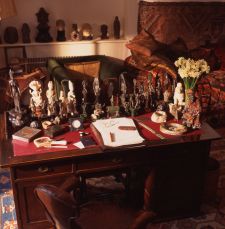
Although Freud lived most of his life in Austria, he was also a Jew during World War II. When Hitler annexed Austria in 1938, Freud was forced to flee to England with his family. He moved to a house in London, where he lived the rest of his life until he died in 1939. It is still filled with many of Freud's original possessions, and often reflect his personal work. Strange paintings and pictures decorate his walls, some with a highly graphic sexual scene. Freud himself was a collector of antiquities, and his office and study are lined with relics taken from Egypt, Asia, and the Mediterranean. His desk was literally covered with small figurines of mythical gods from various religions, and several busts were scattered through his room.
Freud's desk, covered with small deities.

His infamous reclining coach, a common symbol of therapy, lay along a wall, with his chair sitting next to it's head.
The infamous reclining couch. Freud sat in the green chair on it's left, behind the clients head. Here he could listen without interrupting the patient's free association of their thoughts. He sat on this side because his hearing on his right side was damaged due to jaw surgery. He could sometimes sit listening to a patient for up to ten hours.

An audioguide and video gave us an interesting tour of his house, and it was awesome to walk through the footsteps of such an important man, even if I thought he was insane.

After our tour, we were free for the day, so we decided to take a bus to nearby Regent Park. Like most large cities, London has several large parks, and Regents is one of the largest. Walking past it's walls lead to a beautiful park, with trees scattered about green grass.

A series of lakes nearby held a population of ducks, while people paddled around in tiny boats.

Walking out from this lead to green fields setup to host a variety of sports, and further on was the London Zoo. People of all sorts were out enjoying the day, and we happily wandered through the park, exploring whatever we fancied at the moment.

At a certain point we traveled to Queen Mary's Garden, filled with lush flowers, with a fountain in the circle.

There was also an open air theater  one could buy tickets for during the summer. At a certain point, we bought sandwiches and ate them on the grass, watching as people walked dogs and played with small children. But as time passed on, dark clouds formed overhead and began to shower us, an obvious signal that it was time to return home.

After resting in the dorm, we decided that we wanted to see if a nearby pier hosted evening boat rides up and down the Thames. After walking to pier, we found out that the service was closed for the night, but just across the nearby bridge was the London Eye, which at a whim we decided to visit. This giant Ferris wheel was installed in 2000 as a temporary addition to London for the new Millennium, but grew to be so popular it eventually became permanent.

At 443 feet, this behemoth is one and a half times taller than the Statue of Liberty including her pedestal and foundation. 32 glass capsules rotate slowly around it's circumference, taking thirty minutes to complete one revolution. After buying our tickets, we jumped onto our capsule. It moves slowly enough that it doesn't even need to stop; one can calmly walk onboard.

The height of this ride is so impressive it makes for fantastic picture opportunities for all of London. One can view the entire skyline, including Westminster Abby, the Parliament building, bits of Buckingham Palace, and everything else in the London skyline.
A view inside a nearby capsule to show what they look like. For some reason there is a car in this one.

Parliament Building and Big Ben.

We got tons of fantastic pictures, most of which I can't show you.

From the person on the right's album. 


Our timing was perfect as well; we got the second to last capsule before the ride was closed, so as we took pictures, the sun set over London, and the city began to light up. Needless to say, it was pretty awesome.

Having walked an excessive amount this day, we walked back to our flat, passing multiple groups of people who had obviously already hit the pub that evening, though we decided to call it a night.